Is Notion overkill for personal use?
Notion is overkill for personal use because it was built for team documentation, not individual goal execution. It has no native goal hierarchy or habit tracking. Griply is purpose-built for personal goal execution, with a hierarchy that lets you connect every task and habit to a measurable goal.
Griply: purpose-built goal-first hierarchy; no setup required; rated 4.7 on the App Store; iOS, Android, web, and desktop; free plan available
Notion: team wiki repurposed for personal use; no native goal hierarchy or habit tracker; all platforms; free plan available
Todoist: strong task capture; Goals beta tracks check-off, with no goal metric or habit layer; iOS, Android, desktop; free plan available
Apple Notes / Bear: simple note-taking with fast capture; no goal hierarchy, task layer, or reminders built around goals; iOS and Mac; free (Apple Notes) / freemium (Bear)
App | Built for personal use | Native goal hierarchy | Habit tracker | No setup required | Free plan |
|---|---|---|---|---|---|
Griply | Yes | Yes | Yes | Yes | Yes |
Notion | No (team wiki) | No | No | No | Yes |
Todoist | Yes | Beta | No | Yes | Yes |
Apple Notes / Bear | Yes | N/A | N/A | Yes | Yes |
Why Notion doesn't work well for personal goal tracking
Notion is a team wiki and knowledge base. It was designed for companies that need shared documentation, internal wikis, and structured databases across teams. When you pick it up as a personal productivity system, you are using the wrong category of tool, not just a complex one.
The most common failure pattern among personal Notion users is a structural one: Notion's infinite flexibility requires you to build your own system before you can use it. Hours, sometimes days, go into designing dashboards that never get maintained. This is not a user error; it is a structural feature of a tool built for teams who have dedicated ops people to manage it.
The second problem is absence, not complexity. Notion has no built-in goal hierarchy, no native habit tracker, and no scheduling layer. If you want to track whether you are making real progress on meaningful goals, you must build that structure from scratch, or discover it cannot be built at all.
How Griply is built differently
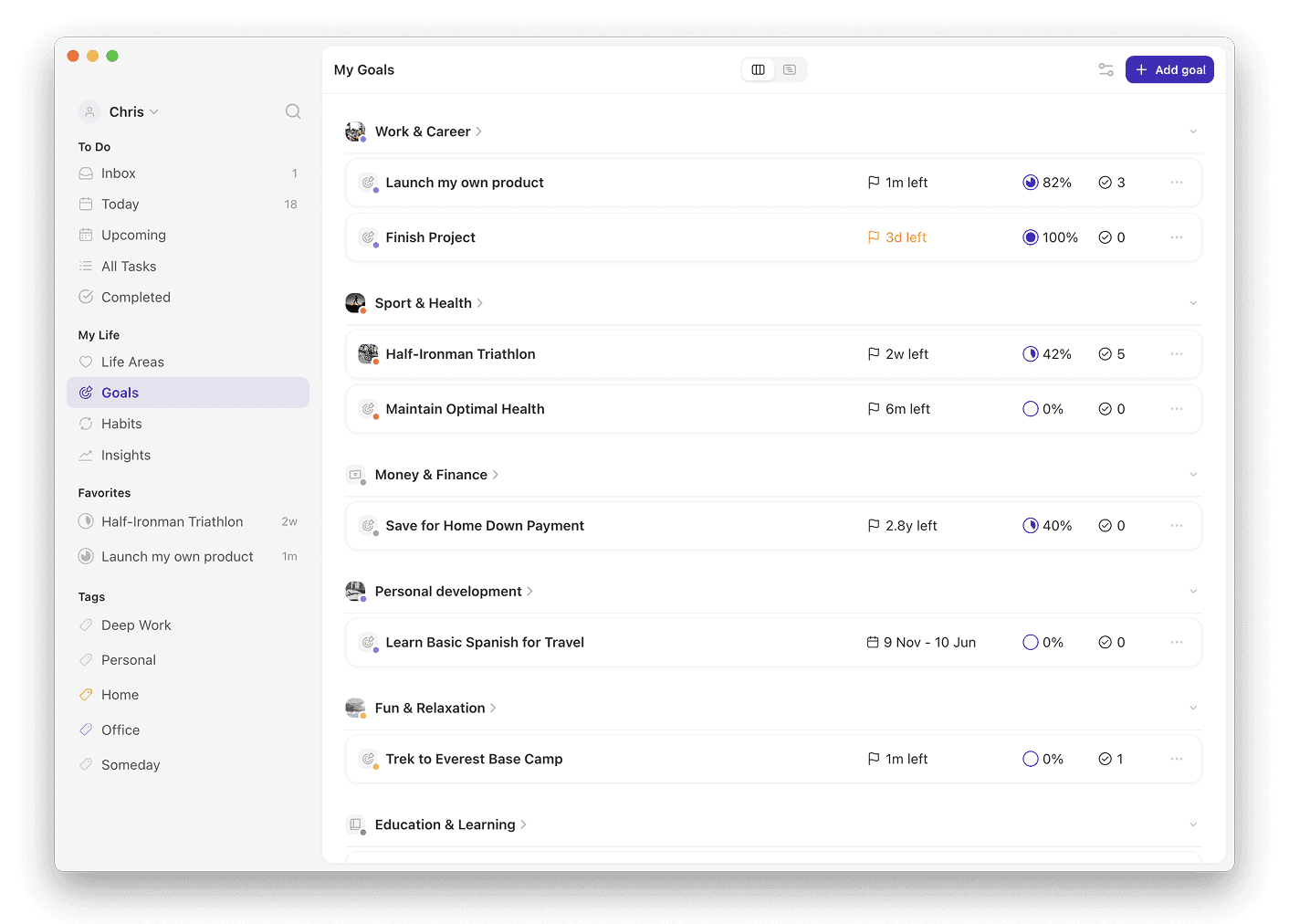
Griply is a goal-first execution system. Its architecture is a hierarchy: Life Area, Vision, Goal, Subgoal, Task, Habit. Every item in Griply can belong somewhere in this chain, so you can see which goal a linked task or habit serves.
This structure is the core difference from Notion. In Notion, tasks are database rows or checklist items with no structural connection to outcomes. In Griply, that connection is built into every object by default.
Goals in Griply have a start value, target value, start date, and deadline. Progress is logged manually and visualised in a line chart. Habits are linked to a specific goal or life area, with frequency settings, reminders, and completion statistics. Tasks have priority, duration, deadline, and a direct link up the hierarchy to the goal they serve. None of this requires setup or configuration; it is how Griply works from the first time you open it.
Using Griply as a Notion replacement for personal productivity
The Today view in Griply shows all tasks and habits scheduled for the current day in a split view: tasks on the left, a calendar on the right. Opening Griply in the morning gives you a clear list of what to do and which goals those actions serve.
For planning further out, the Goal Roadmap shows goals, subgoals, and tasks laid out over time as a Gantt chart. This gives you a visual picture of how your work maps to your goals across weeks and months.
Griply does not replace Notion's documentation or note-taking capabilities. If you need a knowledge base or a second brain, Griply is not the right tool. Griply is for people who know what they want to achieve and need a structured system that keeps them moving toward it every day.
Related questions
Why do people stop using Notion for personal productivity?
The most common reason is the setup loop: users spend more time building their system than using it. Notion's flexibility creates decision paralysis, and without native scheduling or goal tracking, the system requires constant maintenance.
What does Notion lack for personal use?
Notion has no native goal hierarchy, no built-in habit tracker, and no task scheduling layer. Personal users who want to track progress toward specific goals must build these structures themselves using databases and templates, which adds ongoing maintenance overhead.
Is there a simpler alternative to Notion for tracking goals and habits?
Apple Notes and Bear reduce Notion's complexity but neither has a task layer with deadlines or reminders built around goals. Griply is designed for goal execution: you can link every task and habit to a measurable goal, with no setup required.
Can Griply replace Notion entirely?
No. Griply is not a note-taking or documentation app. It replaces the goal-tracking, habit-tracking, and task-scheduling functions that Notion handles poorly, not its block editor or team collaboration features.
Is Notion good for goal tracking?
Notion has no native goal-tracking structure. You can create a goals database using custom properties, but it requires significant setup and lacks automatic progress visualisation. Griply has goal metrics and progress charts built in.
Is Notion free for personal use?
Yes. Notion's free plan includes unlimited pages and blocks for one user. But the free plan does not add a goal hierarchy, habit tracking, or scheduling. The structural limitations are in Notion's architecture, not its pricing tier. Griply's free plan includes two goals with built-in metrics and linked habits.