How to develop good habits connected to a goal
Last updated: 4 September 2026
You build a habit connected to a goal by picking the goal first, then the smallest action that moves it. In Griply you link that habit to the goal, so it appears in the goal's Tasks card and in Today. You log the goal's progress separately.
Why most habit advice skips the goal
Most habit advice stops at the behaviour: make the action small and attach it to a routine you already run. James Clear's case for systems over goals is the clearest version of that argument, and the mechanics hold up.
What it leaves open is which outcome the habit is for. You can run a habit for six weeks, see a completion rate of 80%, and still not know whether the thing you wanted has moved. That gap is the difference between a habit and a goal: a habit measures whether you turned up, a goal measures whether you arrived.
Building the habit from the goal down closes the gap. You decide the outcome first, as a number with a deadline, and the habit is whatever repeatable action produces that number. The goal above the habit is then the reason to act on a low-motivation morning.
What linking a habit to a goal does in Griply
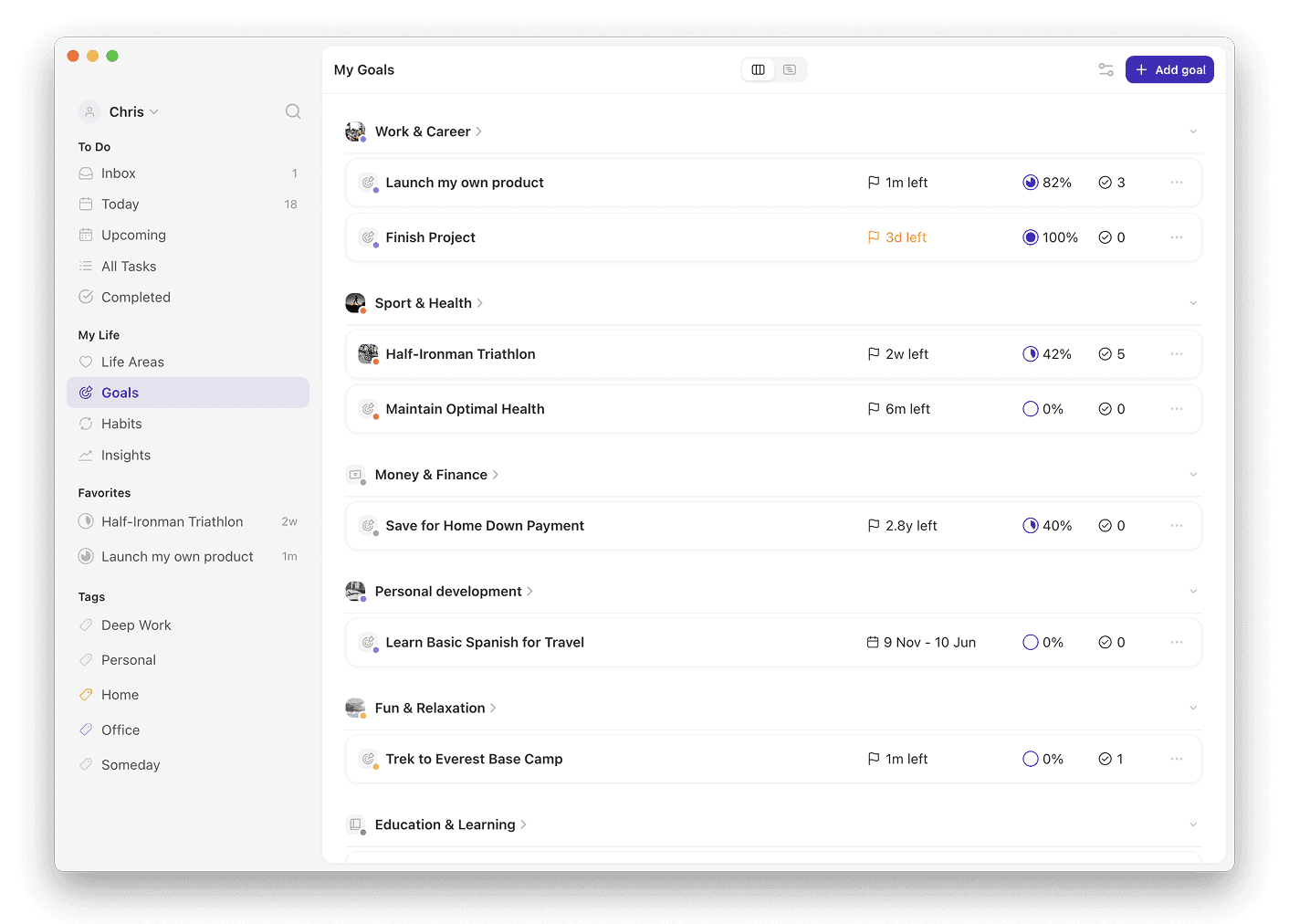
Griply's hierarchy runs Life Area → Vision → Goal → Subgoal → Task/Habit. A habit in Griply is a recurring task with a schedule, so it carries the same optional link a task carries: you attach it to a goal, a subgoal, or a life area. Griply never requires it.
The link is organizational. A habit you link appears in that goal's Tasks card on the Goal detail screen, cascading through every subgoal beneath it, so the daily actions sit under the outcome they serve. The habit also gets its own box inside the goal's Progress card, with that habit's statistics beside the goal's line chart.
On Desktop, clicking that box opens the habit's statistics. The Today view shows the day's habits next to the goal each one serves.
Completing a habit records a habit entry. It does not change the goal's number. Goal progress is logged separately, as its own entry.
How to build the habit step by step
Start with a goal written as a number with a deadline: read 24 books this year, run 60 miles in October. Derive the smallest action that produces that number, small enough to do on a bad day. Then decide when and where you will do it, because writing that plan down took exercise participation to 91% against 35% for a motivation-only group (Milne, Orbell and Sheeran, British Journal of Health Psychology, 2002).
Anchor the action to a routine you already run, and a habit stacking template gives you a reliable cue.
In Griply, create the habit and set its schedule, then link it to the goal it feeds. Pick the goal metric that matches how the outcome is measured: Unit-based when the goal has a real unit such as pages or miles, and log the value as you go. Completed task count fits only when discrete one-off tasks are the units of progress, and habits never count toward it.
Habit statistics carry the habit's own measurement: completion rate and perfect weeks by week, month, quarter or year. Desktop steps back through earlier periods; iOS shows the current period only.
Related questions
What is the difference between a habit and a goal?
A goal is a measurable outcome with a start value, a target and a deadline. A habit is a recurring action on a schedule. The goal tells you where you are going; the habit is the work you repeat to get there.
Do habit completions count toward a goal's progress in Griply?
No. Completing a habit in Griply does not increment a Completed task count goal, which counts one-off tasks only. The habit link is organizational. To make the goal's number move, use a Unit-based metric in the real unit and log the value.
Does a habit have to be linked to a goal in Griply?
No. The link to a goal or a life area is optional on every habit in Griply, the same way it is on a task. An unlinked habit runs on its schedule and keeps its own statistics.
How does Griply compare to Habitica for goal-connected habits?
Habitica gamifies habit streaks and has no deadline-based goal metric, so a habit there tracks repetition with no outcome above it. Griply lets you link a habit to a bigger goal that carries its own target and deadline.
Is Griply free to use?
Griply has a free plan with 2 goals and 2 habits on iOS, web, and desktop. Goal progress charts and habit statistics are free. Premium is $4.99 monthly or $29.99 a year and unlocks unlimited goals and habits, habit targets, subgoals, and the goal timeline.