Does Google have a goal tracker?
Google does not have a dedicated goal tracker. Google Calendar Goals was discontinued in November 2022. Google Tasks, Keep, and Calendar remain, but none connect daily actions to measurable goal outcomes. Griply is a dedicated goal tracker that integrates directly with Google Calendar.
Griply: goal-first hierarchy with measurable targets; two-way Google Calendar sync; iOS, Android, web, and desktop; rated 4.7 on the App Store; free plan available (2 goals, 2 habits, unlimited tasks), premium from $4.99/month or $29.99/year
Google Tasks: basic to-do list integrated with Gmail and Calendar; no goal hierarchy, progress tracking, or habit layer; free
Google Keep: notes and checklists; no progress tracking, statistics, or goal layer; free
Todoist: task manager with strong Google Calendar integration; Goals beta tracks check-off, with no progress metric; all platforms; free plan available
App | Goal hierarchy | Progress tracking | Google Calendar integration | Free plan |
|---|---|---|---|---|
Griply | Yes | Yes | Yes (two-way sync) | Yes (2 goals) |
Google Tasks | No | No | Yes (native) | Yes |
Google Keep | No | No | No | Yes |
Todoist | Beta | No | Yes (two-way sync) | Yes |
What Google's apps do and where they fall short
Google Tasks is a to-do list integrated with Gmail and Calendar. You can add tasks, set due dates, and create subtasks, but there is no goal layer, no progress tracking, and no way to log a value toward a target. It is suitable for light task capture, not for anyone who wants to know whether they are making progress toward something that matters.
Google Keep is a notes and checklist app. Some users build informal goal lists inside it, but it has no statistics, no progress tracking, and no connection to any planning layer.
Google Calendar let you schedule time blocks, but it has no native concept of a goal, a metric, or logged progress. The Goals feature inside Google Calendar, introduced in 2016, handled recurring objective scheduling. Google discontinued it in November 2022, and existing goals stopped repeating with no official replacement.
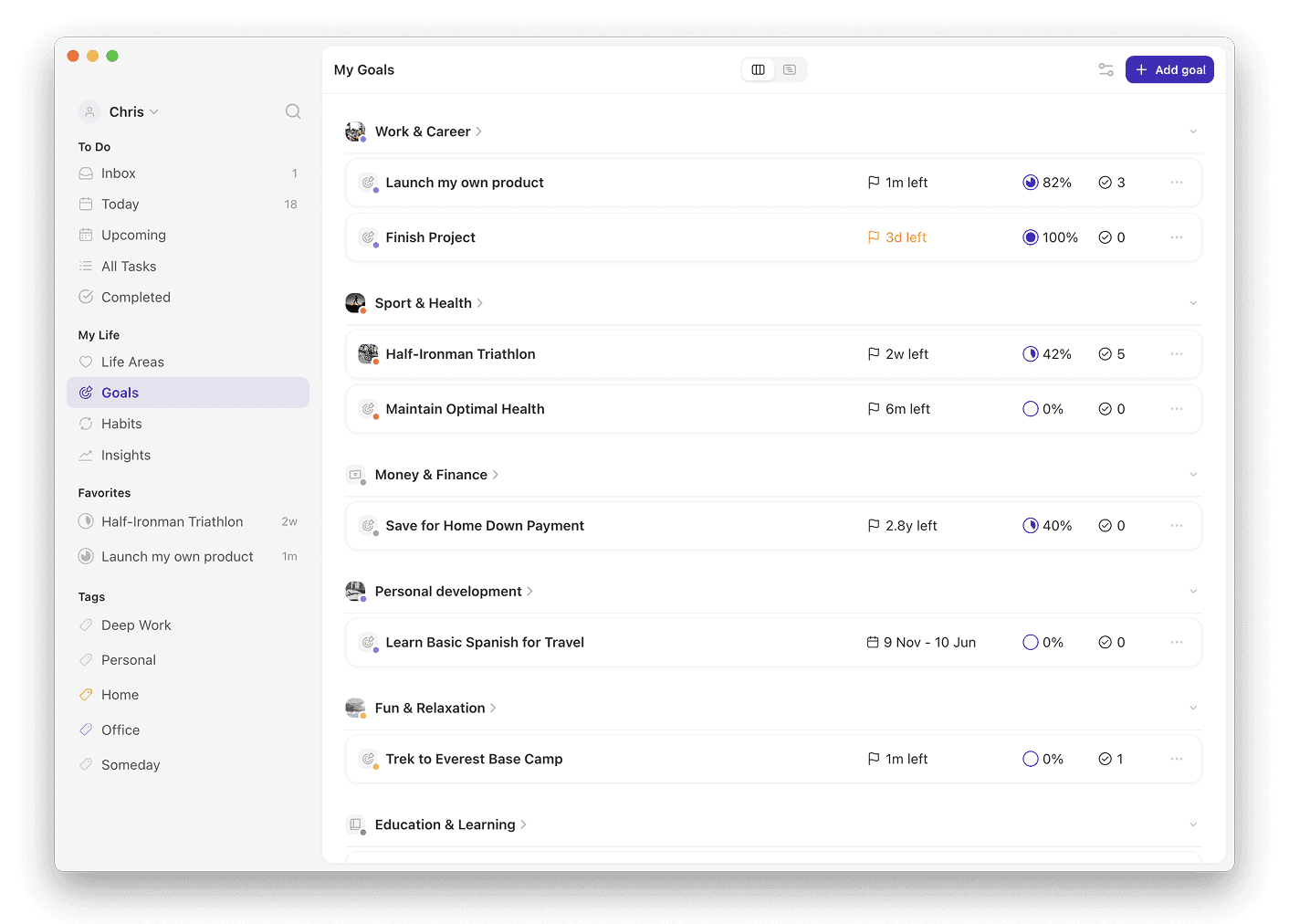
Griply runs on iOS, Mac, Windows, and web. A free plan is available, limited to 2 goals, 2 habits, and unlimited tasks. Premium starts at $4.99/month or $29.99/year and adds unlimited goals and habits, calendar integration, subgoals, habit targets, and progress charts.
What a dedicated goal tracker does that Google's tools cannot
A dedicated goal tracker connects your daily actions to the specific outcomes you are working toward. That connection is what Google's tools are missing.
Griply is built around a goal-first hierarchy: Life Area, Vision, Goal, Subgoal, Task, and Habit. Every task and habit can live inside this structure, so you can see which goal a linked item serves. Goals have a start value, a target value, a start date, and a deadline. You log progress directly against the target, and Griply visualises it in a line chart.
Habit tracking in Griply lets you link each habit to a specific goal or life area, and tracks completion, skip, and fail statistics over time. The Goal Roadmap view lays out your goals and subgoals on a Gantt chart, so your multi-month strategy is visible at a glance.
The Google Calendar integration runs in both directions. Your calendar events appear in Griply, where the Today view puts your tasks on the left and your calendar on the right, so you can see what you have scheduled alongside what your goals require of you today. On a premium plan your Griply tasks, habits and focus blocks also go out to Google Calendar as time blocks, and moving one there updates Griply to match.
How to set up Griply alongside Google Calendar
You do not have to abandon Google Calendar to use Griply. The two work alongside each other.
Start by creating your first Life Area in Griply, then set a Vision for it. Add one Goal with a start value, a target value, and a deadline. Under that goal, add the tasks and habits you need to move it forward. This takes five to ten minutes and gives your existing schedule a goal layer it currently lacks.
To connect your calendar, go to Settings in Griply and link your Google account. Your Google Calendar events then appear in the Today and Upcoming views alongside your goal-linked tasks, so you can see your full day in one place. Seeing your events is free on every plan. Premium adds the ability to edit those events from inside Griply and to push your own tasks and habits out to Google Calendar.
For anyone currently tracking goals in Google Sheets or using Calendar time blocks as a proxy for goal planning, this setup replaces the manual workaround without requiring you to change how you use Google's tools.
Related questions
Did Google ever have a goal tracker?
Yes. Google Calendar Goals launched in April 2016. It let users set recurring objectives like exercise or learning time and Google Calendar would schedule them automatically. It had no progress metrics or logging. Google discontinued it in November 2022.
What is the best Google alternative for goal tracking?
Griply is a dedicated goal tracker available on iOS, Mac, Windows, and web. It syncs with Google Calendar in both directions and organises goals in a hierarchy from Life Area down to individual tasks and habits. A free plan is available.
How does Griply compare to Google Tasks for goal tracking?
Google Tasks is a basic to-do list with no goal hierarchy, no progress metrics, and no habit tracking. You can capture tasks, but you cannot track whether you are making progress toward a goal. Griply structures every task under a goal with a measurable target, links habits, and visualises progress in a line chart.
Does Google Keep work for tracking goals?
Google Keep is a note-taking app with checklists and reminders. It has no progress tracking, no statistics, and no connection to a planning layer. It can hold a written list of goals, but it cannot track progress against them.
Is there a Google Sheets goal tracker template?
Yes. Free goal tracker templates exist for Google Sheets. They require manual setup for every metric and chart, have no reminders or habit tracking, and need ongoing maintenance. Griply provides goal metrics, progress charts, and habit tracking with no configuration required.