Do habit tracker apps work?
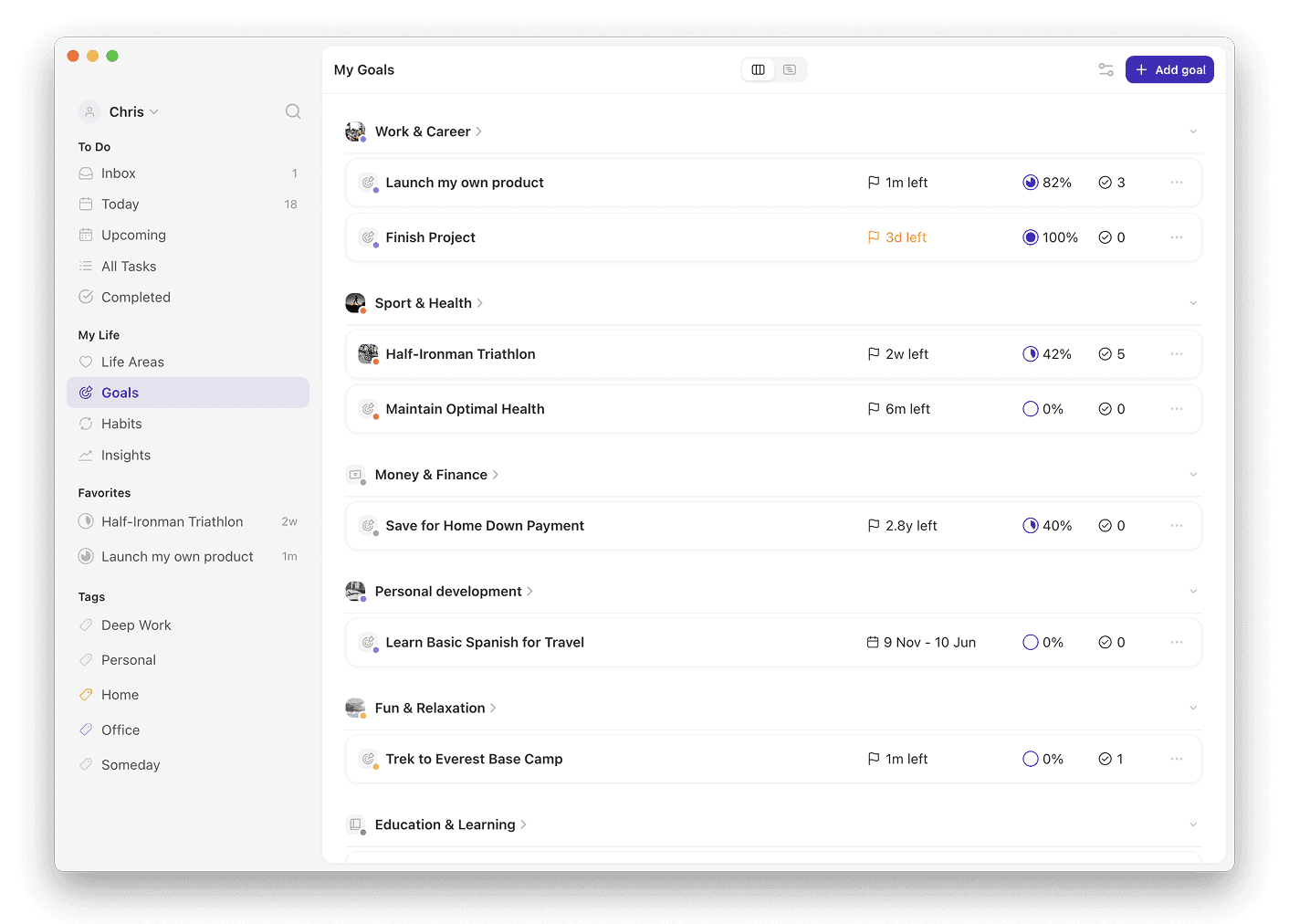
Habit tracker apps work when each habit has a visible reason to continue. Griply lets you link a habit to a bigger goal in its Life Area → Vision → Goal → Habit hierarchy. When a streak breaks, the goal is still there. That structural difference is what separates apps that hold from apps that don't.
Apps with goal context (Griply): connect habits to measurable goals; when a streak breaks, the goal remains as motivation; rated 4.7 on the App Store; iOS, Android, web, and desktop; free plan available
Streak-only apps (Streaks, Habitica): track consistency without goal context; engagement drops sharply when streaks break
Habitify: clean interface with detailed statistics; no goal layer connecting habits to outcomes; iOS, Android, desktop; freemium
Paper or spreadsheet: work for some users; no automated reminders or visual progress charts
App | Goal layer | Tracks skips/fails | Progress chart | Free plan |
|---|---|---|---|---|
Griply | Yes | Yes | Yes | Yes |
Streaks | No | No | No | No |
Habitica | No | No | No | Yes |
Habitify | No | Yes | Yes | Yes |
Why most habit tracker apps fail before the 66-day mark
Research by Phillippa Lally et al., published in the European Journal of Social Psychology (2010), found that habit formation takes an average of 66 days, not the widely cited 21. The range across 96 participants was 18 to 254 days. Critically, missing a single day did not disrupt the formation process.
The problem with streak-based apps is structural. Streaks make the streak itself the goal. When it breaks, loss aversion kicks in: users experience it as failure and disengage entirely rather than resume. People who think in binary success/failure terms are significantly more likely to abandon a goal after the first missed day.
The Lally research also found that automaticity depended on consistent context and outcome, not on an unbroken count. An app that only shows you a streak counter gives you no context and no outcome. Numbers alone do not motivate behavior.
How Griply addresses the structural problem
In Griply, a habit can be linked to a subgoal or life area through the full hierarchy: Life Area → Vision → Goal → Subgoal → Habit. You set the frequency and can add a reminder, and Griply tracks completion, skips, and fails over time.
The reason to continue is visible at every level. If you track a daily run, it is attached to a goal with a start value, a target value, and logged progress shown as a line chart. When you skip a day, the goal does not disappear. The habit still points to something that matters.
Griply is not a standalone habit app. The full stack is the product. A habit in isolation is just a counter. A habit inside a goal hierarchy has a reason to exist beyond the streak.
How to set up a habit in Griply so it sticks
Start by defining a life area: Sport & Health, Work & Career, or whichever area the habit belongs to. Write a vision statement for that area. Then set a goal with a measurable start and target value and a deadline.
Under that goal or a subgoal, create the habit. Name it specifically. Set a frequency that reflects what you can actually sustain, not an ideal. Add a reminder at a time that follows a consistent context in your day. After an existing routine works better than an arbitrary time.
When you mark the habit complete, Griply records it in your completion statistics. When you skip, that is recorded too. The data is honest. The iOS habit heat map widget shows your full month grid of completions, skips, and fails at a glance. The point is not to show a perfect grid. The point is to see whether the habit is moving toward the goal.
Related questions
How long does it take for a habit tracker app to work?
Based on Lally et al. (2010), average automaticity takes 66 days, with a range of 18 to 254 days. Missing a single day does not disrupt formation. An app provides structure but does not accelerate the underlying biology.
Why do people stop using habit tracker apps?
The most common failure mode is the streak breaking. When the streak resets, users with binary success/failure thinking have no structural reason to restart, so they disengage. Apps that connect habits to goals preserve a reason to resume because the goal is still active regardless of the streak count.
What makes a habit tracker app effective?
Effectiveness comes from connecting the habit to a stated purpose. Stawarz, Cox, and Blandford (CHI 2015) reviewed 115 habit formation apps and found that apps providing contextual cues and implementation intentions outperformed those relying on gamification. Apps that only log completions without connecting them to outcomes show sharp engagement decline after 30 days.
Is there research on habit tracking apps?
Stojanovic, Grund, and Fries (Frontiers in Psychology, 2020) found app-based habit building reduced motivational impairments and produced measurable benefits. Harkin et al. (Psychological Bulletin, 2016) confirmed across 19,951 participants that self-monitoring significantly increases goal attainment rates compared to no tracking.
How does Griply compare to a streak-only habit app?
Streak apps make the streak itself the goal, so when it breaks, the motivational structure collapses. Griply attaches a habit to a bigger goal with a measurable metric, so the reason to continue exists independent of the streak count.