What is a habit tracker?
A habit tracker is a tool that records whether you completed a target behaviour on a given day. The core mechanic is binary: done, or not done. Griply's habit tracker lets you connect a habit to a bigger goal in a structured hierarchy, so a tracked behaviour can carry an explicit purpose.
Griply: habit tracking linked to goals in a structured hierarchy; streak stats, heat map widget, and completion logging; rated 4.7 on the App Store; iOS, Android, web, and desktop; free plan (2 habits), Premium $4.99/month or $29.99/year
Streaks: Apple Design Award winner; tracks up to 24 habits with streak counts; no goal layer or hierarchy; iOS and macOS; $4.99 one-time purchase
Habitify: clean daily tracker with detailed statistics and flexible scheduling; no goal connection; iOS, Android, macOS; free plan (3 habits), Pro $4.99/month
Habitica: gamified habit tracker using RPG mechanics for motivation; no goal metric or progress tracking; iOS, Android, web; free plan available
Paper / bullet journal: zero cost, fully customisable grid; no reminders, no streak automation, no goal linking; requires manual maintenance
App | Goal layer | Habit streaks | Links habits to goals | Free plan |
|---|---|---|---|---|
Griply | Yes | Yes | Yes | Yes |
Streaks | No | Yes | No | No |
Habitify | No | Yes | No | Yes |
Habitica | No | Yes | No | Yes |
Paper / journal | No | Manual | No | Yes |
Why habit trackers work
The theoretical foundation comes from Charles Duhigg's The Power of Habit (2012), which described behaviour as a cue-routine-reward loop. James Clear built on this in Atomic Habits (2018), arguing that a habit tracker activates three of his Four Laws of Behavior Change simultaneously: it is an obvious cue (Law 1), an attractive progress signal (Law 2), and a satisfying completion marker (Law 4).
Clear recommends starting with no more than three to five habits and following a "never miss twice" rule. The visual chain of completed marks is itself motivating. Research cited by Berkeley Wellbeing shows that monitoring behaviour strengthens self-control over time, and a Kaiser Permanente study (Hollis et al., 2008) of over 1,600 people found that those who kept daily food logs lost twice as much weight as those who did not.
Most habit trackers, whether paper-based, spreadsheet, or app-based, operate as standalone behaviour logs. The limitation is that behaviour without goal-context can leave you optimising habits that do not serve your actual priorities.
How Griply handles habit tracking
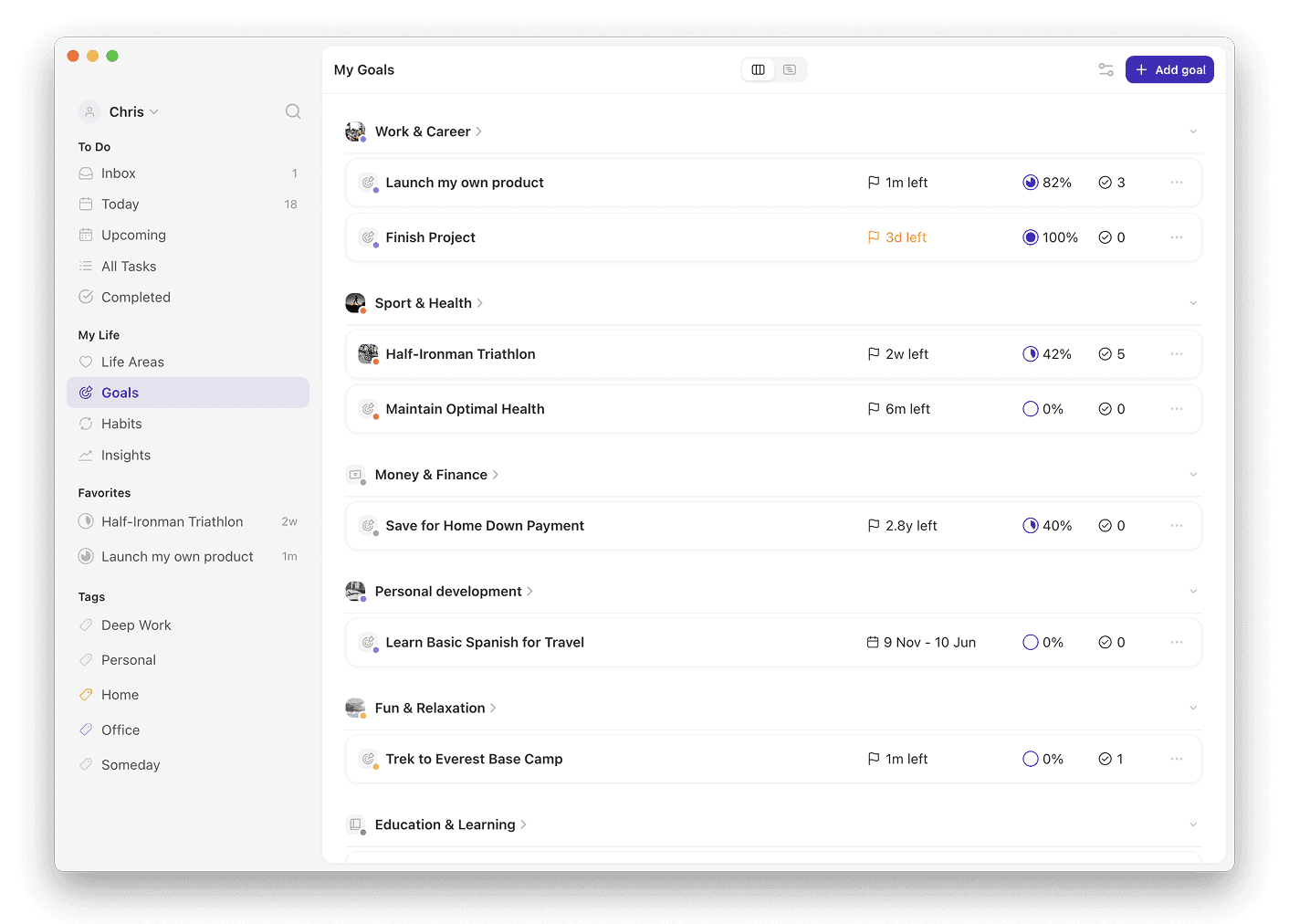
Griply's habit tracker is not a standalone behaviour log. Habits in Griply live inside the same hierarchy as tasks and goals: Life Area, Vision, Goal, Subgoal, then Habit. A habit can be linked to a subgoal or life area, which means you can see which bigger goal a habit serves.
Each habit in Griply has a name, a set frequency, an optional reminder, and completion, skip, and fail statistics. On iOS, a habit heat map widget shows a month-grid of completion data, and a habit list widget shows eight habits with checkboxes for every day of the current week.
The free plan supports two habits. Griply Premium ($4.99/month or $29.99/year) unlocks unlimited habits, habit targets, and progress charts. A lifetime licence is available at $119.99.
See the full Habit Tracker feature page for current capabilities.
Using Griply to build a tracked habit
Start by creating a Life Area in Griply (for example, Sport & Health). Set a Vision statement under that life area, then create a Goal with a measurable target and deadline. Under that goal, add a Subgoal that represents a specific milestone.
Once the goal structure exists, add a habit at the subgoal level. Name it specifically (for example, "30-minute walk" rather than "exercise"), set a daily or weekly frequency, and add a reminder time. Griply will log each completion, skip, or fail and display the streak in the statistics view.
The hierarchy means you see every habit in context. If a habit is no longer serving its parent goal, that is visible before weeks of effort go in the wrong direction.
Related questions
What is the difference between a habit tracker and a to-do list?
A to-do list records discrete tasks with a defined endpoint. A habit tracker records recurring behaviours you want to maintain over time, with no single completion date. For a full comparison, see Habit Tracker vs Task Manager.
What habits should I track?
Start with three to five behaviours tied directly to an active goal. James Clear recommends limiting the number to avoid tracker overload. For specific ideas across health, work, and learning, see Habit Tracker Ideas.
Why do most habit trackers fail people?
Standalone habit trackers record behaviour without goal context. When a habit is disconnected from a reason, motivation drops when the novelty of the streak fades. Attaching each habit to a goal you have committed to gives it a stable anchor.
How does Griply compare to Streaks or Habitify for habit tracking?
Streaks and Habitify track behaviour consistency without goal context. Griply lets you link a habit to a bigger goal in a structured hierarchy, so you know which outcome a habit is serving, on top of whether you completed it.
Does Griply work as a standalone habit tracker?
Griply includes full habit tracking, but is most effective when habits connect to goals and life areas. Using only the habit layer is possible. If you want only a habit log with no goal context, a dedicated habit app suits you better.