What is the best habit tracker for ADHD?
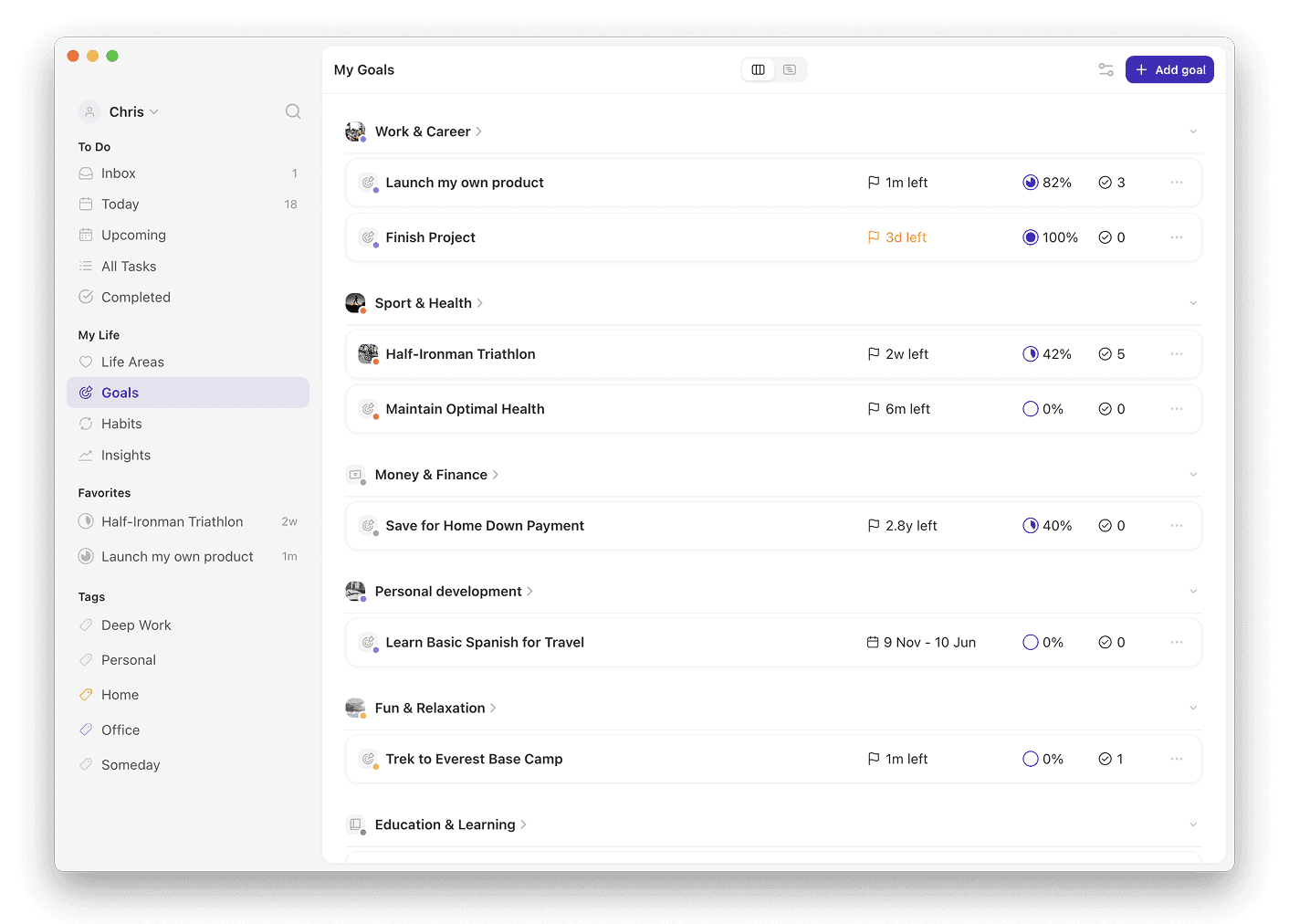
Griply addresses the core reason habit trackers fail ADHD users: habits disconnected from goals lose relevance fast. Griply lets you link a habit to a bigger goal, replacing arbitrary repetition with intention.
Griply: A habit can link to a bigger goal within a Life Area, Vision, Goal hierarchy; iOS, Android, web, and desktop; free plan (2 habits); 4.7 App Store rating
Habitica: RPG mechanics create short-term dopamine reward, but no architecture connects habits to long-term goals; iOS and Android; free plan available
Focus Bear: Built for ADHD with distraction blocking during habit blocks; no goal hierarchy; iOS and macOS; paid only (from $4.99/month)
TickTick: Habit tracker within a task manager; popular for its free tier, but has no goal hierarchy; iOS, Android, desktop; free plan available
Streaks: Low-friction interface; no goal context; iOS only; $4.99 one-time
App | Goal layer | Habit layer | Links habits to goals | Free plan |
|---|---|---|---|---|
Griply | Yes | Yes | Yes | Yes |
Habitica | No | Yes | No | Yes |
Focus Bear | No | Yes | No | No |
TickTick | No | Yes | No | Yes |
Streaks | No | Yes | No | No |
Why standard habit trackers fail ADHD users
Three failure modes appear consistently when ADHD users try standard habit trackers.
Time blindness. A single daily reminder is ineffective. An app that sends one notification at 9am does nothing for a user who loses track of two hours by 10am. ADHD users need a today-focused view that surfaces what is due right now.
Task initiation paralysis. A long list of unchecked habits becomes an avoidance trigger. Opening an app that shows ten incomplete items creates enough friction to close it. ADHD users need one clear answer to "what do I do right now."
Streak-based shame loops. Missing a single day produces disproportionate shame. Apps that record completions, skips, and fails without punishing a missed day reduce this pattern.
Focus Bear addresses ADHD specifically with distraction blocking during habit blocks, but it has no goal hierarchy connecting habits to outcomes. The habits exist in isolation, which is the same structural gap most trackers have.
How Griply's goal-habit architecture addresses ADHD needs
The core problem is not missing reminders: habits disconnected from meaning fail fast. ADHD brains require perceived relevance to sustain engagement. A habit with no stated reason becomes arbitrary.
Griply organizes everything in a hierarchy: Life Area, Vision, Goal, Subgoal, Task, Habit. When you create a habit, you link it to a subgoal or life area. You are not tracking "exercise daily" in isolation; you are tracking it as part of a goal with a start value, target value, and a progress line chart.
The Today view shows all tasks and habits scheduled for the day on one screen. Per-habit reminders let you set a push notification for a specific time on a specific habit. Individual habit repetitions can each be dragged to a different time and day in the calendar view, while staying linked to the same habit record.
How to use Griply for an ADHD-friendly habit routine
Create one Life Area and one Goal before adding any habits. Habits without goal context have no anchor and behave like any other list-based tracker.
Add two habits linked to the same goal. Set a specific reminder time for each. Use the iOS Habit heat map widget to see a month grid of completions, skips, and fails without opening the app. Add a third habit only after the first two are consistent for two weeks.
Related questions
Is Griply specifically designed for ADHD?
Griply is a goal-linked habit tracker built for anyone who wants habits connected to meaningful goals. It addresses the root cause of ADHD habit failure: habits disconnected from goals lose relevance fast. It is not clinical ADHD software.
How does Griply compare to Habitica for ADHD?
Habitica uses gamification to generate dopamine reward, which works for ADHD users who need external motivation. Griply provides goal context instead, which works for users who need habits to feel purposeful. Habitica has no goal hierarchy; Griply lets you link a habit to a bigger goal.
Do habit tracker apps actually work for ADHD?
Habit trackers work for ADHD when habits connect to goals the user already cares about and the app removes friction at the moment of use. See Do habit tracker apps work? for the research.
What is the difference between a habit tracker and a task manager for ADHD?
A habit tracker records repeated behaviors on a schedule. A task manager handles one-off actions with deadlines. ADHD users benefit from one tool that handles both in the same goal hierarchy. See Habit tracker vs task manager.
How many habits should an ADHD user track at once?
Start with two habits linked to the same goal. Tracking too many at once triggers initiation paralysis and causes abandonment. Add a third habit only after the first two are consistent for two weeks.
What features should a habit tracker have for ADHD?
It should address time blindness with per-habit reminders and a today-focused view, reduce initiation paralysis by showing one clear next action, and avoid streak-based shame by recording skips and fails without punishment. Most importantly, every habit should link to a goal so it has a stated reason to exist.