Guide


Table of Contents
As the year draws to a close, there is a natural urge to look back. But for many, this process is a fleeting, unstructured thought, a quick mental scan of the highlights and low points. This often leads to impulsive New Year's resolutions that are abandoned by February.
In fact, research from the University of Scranton suggests a staggering 92% of people never achieve their long-term ambitions, largely because their goals are disconnected from their daily lives.
A truly effective end-of-year reflection is different. It is a deliberate, structured process, a personal annual review that allows you to mine your experiences for valuable data. It is about asking the right questions to understand what energized you, what drained you, where you grew, and where you stumbled.
This guide provides a simple, step-by-step process for conducting a meaningful end-of-year reflection that will give you the clarity and direction needed to design your most intentional year yet.
Key Takeaways
The Purpose of Reflection: An end-of-year reflection is a structured process for analyzing your past year to uncover lessons, celebrate wins, and gain the clarity needed to set meaningful goals for the future.
A 4-Step Framework: A successful reflection follows a clear process: 1. Prepare by setting aside time, 2. Review your year across key life areas, 3. Analyze your findings to identify patterns, and 4. Synthesize your insights into a plan for the year ahead.
Go Beyond a Simple List: The most powerful reflections are written down. The act of writing makes your insights tangible and increases your likelihood of acting on them.
Bridge the "Goal-Action Gap": Most resolutions fail because they are disconnected from daily actions. The ultimate goal of a reflection is to bridge this gap by using an integrated system to connect insights directly to daily tasks.
Step 1: Prepare Your Reflection
A quality reflection requires a quality environment. This isn't something to rush through during a lunch break. To get the most out of this process, you need to prepare.
Schedule the Time: Block out 60-90 minutes of uninterrupted time in your calendar. Treat this as a non-negotiable appointment with yourself. Your future self will thank you.
Gather Your "Data": Your memory is a good start, but it's often unreliable. Before you begin, gather materials that can jog your memory about the year, such as your calendar, photos, journals, or even your work project list.
Use a (Digital) Journal or Planning Tool: Capturing your thoughts in writing makes them more concrete and actionable. Research by Dr. Gail Matthews at Dominican University found that you are 42% more likely to achieve your goals just by writing them down. Using a digital tool makes it easier to revisit, refine, and build on your reflections over time.
Step 2: Review Your Year with a Holistic Framework
The most common mistake in reflection is focusing on just one area of life, like your career. A meaningful reflection looks at your life as a whole.
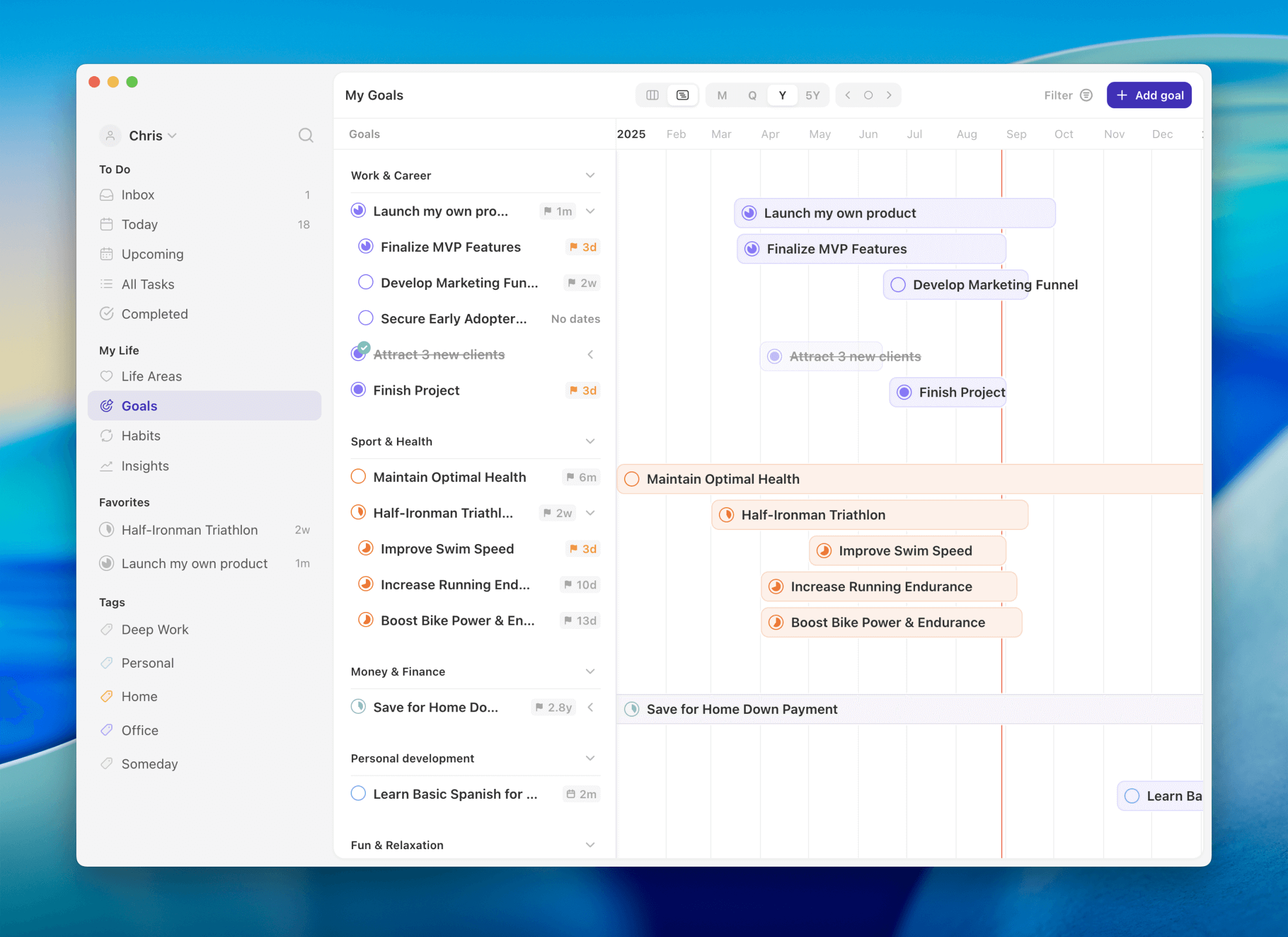
The best way to do this is to use a structured framework, breaking your year down into key "Life Areas". This approach aligns perfectly with a holistic planning system. In a tool like Griply, these would be your Life Areas, allowing you to see how different parts of your life interact.
Below are the most common Life Areas. We have selected the essential questions for each category to help you uncover the most valuable insights. If you want to dig deeper, you can access our full list of 📘 101 End-of-Year Reflection Questions here.
1. General Overview: The Big Picture
Start with a high-level view to capture the main themes of 2025.
If you had to describe 2025 in three words, what would they be and why?
What was your single biggest achievement, and what are you most proud of?
What was the most important lesson you learned this year?
What was the best decision you made?
What new habit did you start that had a positive impact on your life?
2. Work & Career
Your job, professional growth, and accomplishments.
The Energy Audit: Which project or task energized you the most? Which one drained you?
What new skills did you acquire, and how did you use them?
Did your work align with your core values?
How did your relationships with your colleagues and manager evolve?
Did you step out of your comfort zone professionally?
3. Sport & Health
Your physical and mental well-being.
When did you feel most energized and alive?
Did you prioritize your well-being, or did it take a backseat?
What new habits did you start that supported your mental or physical health?
Did you get enough quality sleep? What helped or hindered it?
How did you manage stress and prevent burnout this year?
4. Money & Finance
Your budget, savings, and financial goals.
What financial goals did you reach this year?
Did you stick to your budget? If not, where did you overspend?
What was your biggest financial win?
What purchase do you regret the most?
What is one financial habit you want to build next year?
5. Relationships (Family, Friends, & Love)
Your connections with family, friends, and your partner.
Which relationships did you nurture the most this year?
Who was the best new person you met?
Did you set healthy boundaries in your relationships?
Who are you most grateful for this year?
6. Personal Development & Learning
Your hobbies, new skills, and intellectual curiosity.
How are you different now than you were one year ago?
What was the best book you read this year?
What belief or assumption of yours was challenged this year?
What new hobby or interest did you discover?
Who do you want to become next year?
Sometimes, all it takes is one specific question to unlock a major realization. If you haven't found that spark yet, look through our extensive list of 📘 101 End-of-Year Reflection Questions to find the prompt that resonates with you.
Step 3: Analyze Your Findings to Identify Patterns
Once you've written down your memories and experiences for each life area, the next step is to analyze them. This is where you move from simply reporting what happened to understanding why it happened.
Look for recurring themes and patterns by asking these analytical questions:
What Energized Me? Look through your notes and highlight the moments, projects, or relationships that gave you the most energy and joy.
What Drained Me? Be honest about the activities, responsibilities, or situations that left you feeling depleted or uninspired.
What Was My Biggest Win? Identify the accomplishment you are most proud of, and then ask: What skills or actions led to that success?
What Was My Biggest Lesson? Look at a failure or a challenge and ask: What did this experience teach me that I can carry forward?
Step 4: Synthesize Your Insights for 2026
This is the most critical step. A reflection without a plan for the future is just nostalgia. The entire purpose of this exercise is to use your insights to design a better year ahead.
This is where you bridge the "Action-Purpose Gap". This gap - the disconnect between long-term goals and daily action - is why most plans fail. The insights from your reflection must be translated into concrete goals and an actionable system.
Here's how to do it:
1. Identify the Signal (The Insight) Look at your answers. Where is the strongest pain point or the biggest excitement?
Insight: "I realized I felt sluggish and drained because I sacrificed my physical health for work deadlines."
2. Define the Destination (The SMART Goal) Don't just say "Get healthy." Create a Specific, Measurable, Achievable, Relevant, and Time-bound goal.
Goal: "Complete a 10K race in under 60 minutes by November 1st, 2026."
3. Build the System (The Habits & Tasks) A goal is just a wish until it's planned in your calendar. Break that goal down into recurring habits and one-off tasks.
Habit: "Run for 30 minutes every Tuesday and Thursday morning at 7:00 AM."
Task: "Buy proper running shoes by Saturday."
Task: "Download 10K training plan."
You have done the hard work of reflecting. Now, let’s turn those lessons into a roadmap:
The Ultimate Guide to Planning a Meaningful 2026
Turn your insights into a plan
Learn more
Frequently Asked Questions (FAQ)
How do you write a good reflection example?
A good reflection moves beyond just describing what happened. It includes your personal feelings about the event, connects it to your past experiences, and, most importantly, explains what you learned and what you will do differently in the future.
What are the 5 R's of reflection?
The 5 R's are a popular framework for structuring a reflection: Reporting (what happened?), Responding (what were my reactions?), Relating (how does it connect to my experience?), Reasoning (why did it happen?), and Reconstructing(what will I do differently next time?).
How do you reflect on the end of the year?
The best way is to set aside dedicated time, use a journal, and review your year across different life areas (like career, health, and relationships). Use guiding questions to prompt your memory and uncover insights that you can then use to plan for the year ahead.
Conclusion
Writing an end-of-year reflection is one of the most powerful actions you can take to ensure your next year is more intentional than your last. It provides the data-driven insights needed to move beyond vague resolutions and create a meaningful, actionable plan .
By following this step-by-step process, you can transform the lessons of your past into the roadmap for your future.
Ready to turn your reflections into an actionable plan for 2026? See how Griply can help you build your most intentional year yet.
Works Cited
Norcross J. C., Vangarelli D. J. "The resolution solution: longitudinal examination of New Year's change attempts." National Library of Medicine, 1988, https://pubmed.ncbi.nlm.nih.gov/2980864/
Matthews, Gail. "Study focuses on strategies for achieving goals, resolutions." Dominican University of California, 2015,
https://scholar.dominican.edu/cgi/viewcontent.cgi?article=1265&context=news-releases.