Why are people leaving Notion?
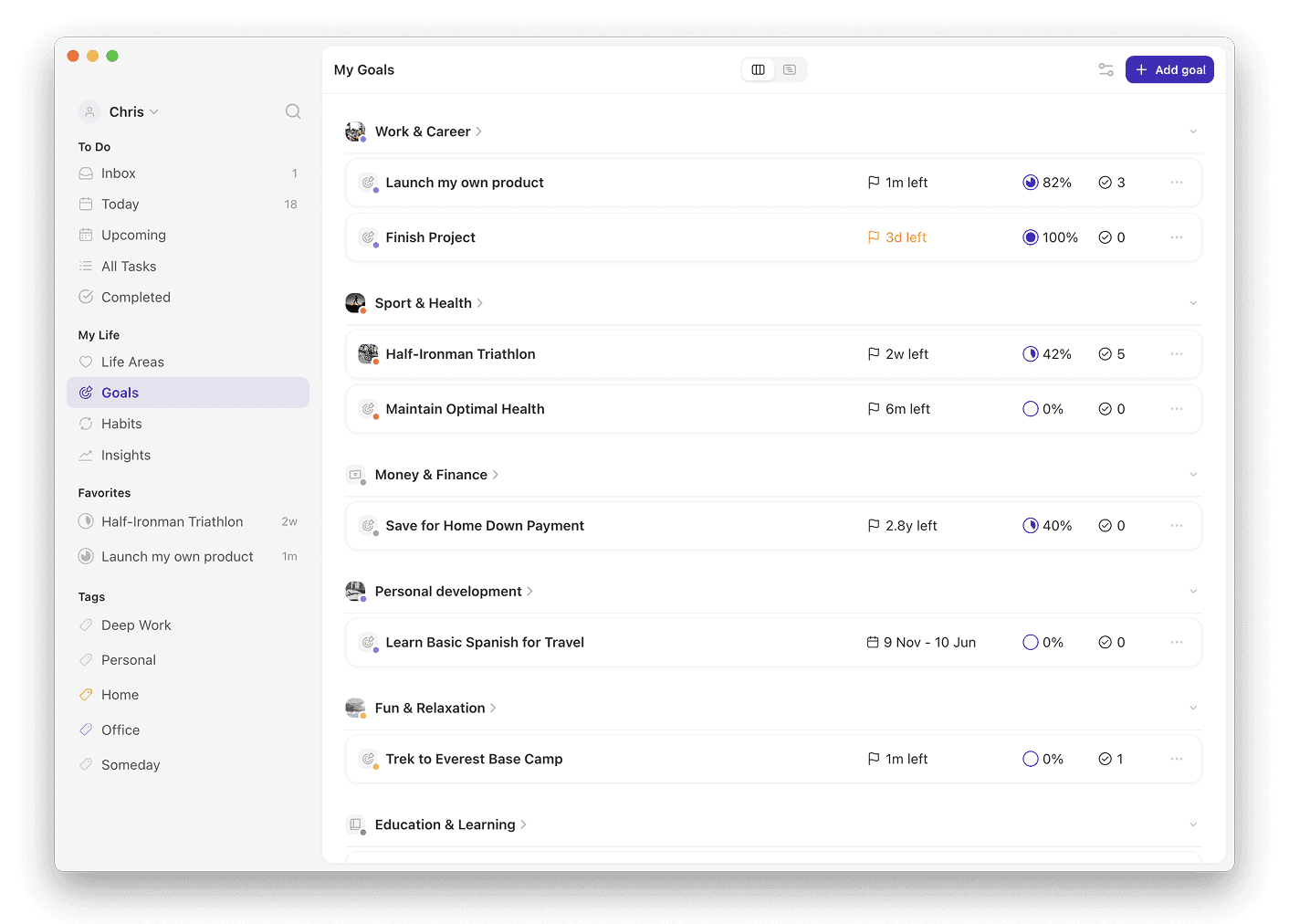
People leave Notion because the tool requires constant architectural maintenance to do work it was never designed for. Notion has no native goal hierarchy and no built-in habit tracking. Griply is built on a goal-first structure: Life Area, Vision, Goal, Task, and Habit are connected by design.
Notion: document-first; no native goal hierarchy, habit tracker, or task scheduling; requires constant maintenance for personal productivity; all platforms; free
Griply: goal-first hierarchy built in; habits and tasks connect to goals by default; rated 4.7 on the App Store; iOS, Android, web, and desktop; free plan available
Obsidian: local-first note-taking and knowledge base; no goal or habit layer; all platforms; free
Anytype: local-first, open-source Notion alternative; no native goal hierarchy or habit tracking; all platforms; free
App | Goal hierarchy | Habit tracking | Mobile experience | No setup required | Free plan |
|---|---|---|---|---|---|
Griply | Yes | Yes | Full parity with desktop | Yes | Yes |
Notion | No | No | Limited (cloud-dependent) | No | Yes |
Obsidian | No | No | Full (local-first) | No | Yes |
Anytype | No | No | Full (local-first) | No | Yes |
The setup loop: when the system becomes the work
Notion's flexibility is a trap. Because everything can be customised, users feel compelled to keep customising: tweaking databases, rebuilding templates, adjusting filters. The app becomes a maintenance project.
This pattern is most acute when people try to use Notion as a personal planning tool or life OS. There is no pre-built structure to constrain them, so every decision about how to organise becomes another decision to make. Users in r/Notion and r/productivity consistently report spending more time building the system than using it.
The structural problem is that Notion is document-first. It was designed to store and display information, not to track progress toward goals or surface what you should be doing today. No amount of template building changes the underlying architecture.
How Griply addresses the structural gaps
Griply is built on a goal-first hierarchy: Life Area, Vision, Goal, Subgoal, Task, and Habit. Tasks can sit anywhere in this chain, and a linked task shows which goal it serves.
Goal progress is tracked with a start value, a target value, and logged entries visualised as a line chart. You log progress manually; the act of logging keeps you connected to the goal. Habits are linked to goals in the same hierarchy, so each habit has a stated purpose. The Today view shows tasks and calendar side by side, surfacing which goals today's actions serve.
On mobile, Griply has full feature parity with the desktop app. iOS widgets show the habit heat map, goal progress, and tasks for today. This is a direct response to Notion's mobile experience, which users consistently describe as a diminished afterthought unsuitable for creating or organising content.
How Griply is structured differently from Notion
Notion starts with a blank page and asks you to build everything. Griply starts with a structure that is already in place and asks you to fill it in.
There is no setup loop because there is nothing to architect. You create a Life Area, set a Vision, add a Goal with a metric, attach Subgoals, and then create Tasks and Habits that connect to those Subgoals. The Goal Roadmap gives you a Gantt chart view of your goals and subgoals over time. The Inbox captures tasks that are not yet linked to a goal.
Griply is execution-focused. It is not a note-taking app, a second brain, or a document editor. Users who need a PKM or want to write long-form notes need a different tool. Griply is for people who know what they want to achieve and need a system that keeps them moving toward it.
Related questions
Is Notion good for personal goal tracking?
Notion has no native goal tracking. Users who want to connect tasks to goals must build their own system from templates, which requires ongoing maintenance. Purpose-built tools like Griply include goal hierarchies, progress metrics, and habit tracking by default.
What do people use instead of Notion?
Users leaving Notion typically split into two groups: those who want local-first note-taking (Obsidian, Anytype) and those who want a structured planning tool with goal tracking (Griply). The choice depends on whether the primary need is information storage or goal execution.
Does Notion have a habit tracker?
Notion has no native habit tracker. You can build a habit-tracking database using templates, but it requires manual setup and has no connection to a goal hierarchy. Griply has a built-in habit tracker where each habit can link to a goal or subgoal.
How does Griply's mobile app compare to Notion's?
Notion's mobile app is cloud-dependent and widely reported as slow, with lag on page opens and poor support for editing databases on a phone. Griply's iOS app has full feature parity with the desktop version, including goal progress, habits, calendar integration, and home screen widgets.