Goals vs objectives: what is the difference?
A goal is a broad, long-term outcome you want to reach. An objective is a short-term, measurable outcome that proves you are moving toward that goal. In Griply, this split maps to the Goal and Subgoal objects inside the Goal-First hierarchy.
The widely-agreed definition
Across business, academic, and productivity sources, the split is consistent. A goal is broad and long-term. An objective is specific, measurable, and time-bound. Objectives sit under goals. Goals sit under a vision or mission.
A concrete personal example: the goal is "get in the best shape of my life by December 2026." The objectives underneath it are "run a sub-25-minute 5K by June," "bench 1.2x bodyweight by August," and "lose 8kg of body fat by October." Each objective has a number, a deadline, and a clear way to check it off.
The frame traces back to Peter Drucker's The Practice of Management (Harper & Brothers, 1954), which introduced Management by Objectives. Andy Grove extended it into OKRs at Intel, documented in High Output Management (Random House, 1983). John Doerr popularised OKRs more widely in Measure What Matters (Portfolio, 2018). The SMART framework, published by George T. Doran in Management Review (1981), is the criteria most often applied to objectives to keep them specific and measurable.
Why the enterprise frame does not fit one person
Most pages ranking for this query write for teams. They describe quarterly objective-setting ceremonies and cross-department key-result negotiation. That scaffolding is built for a 500-person org.
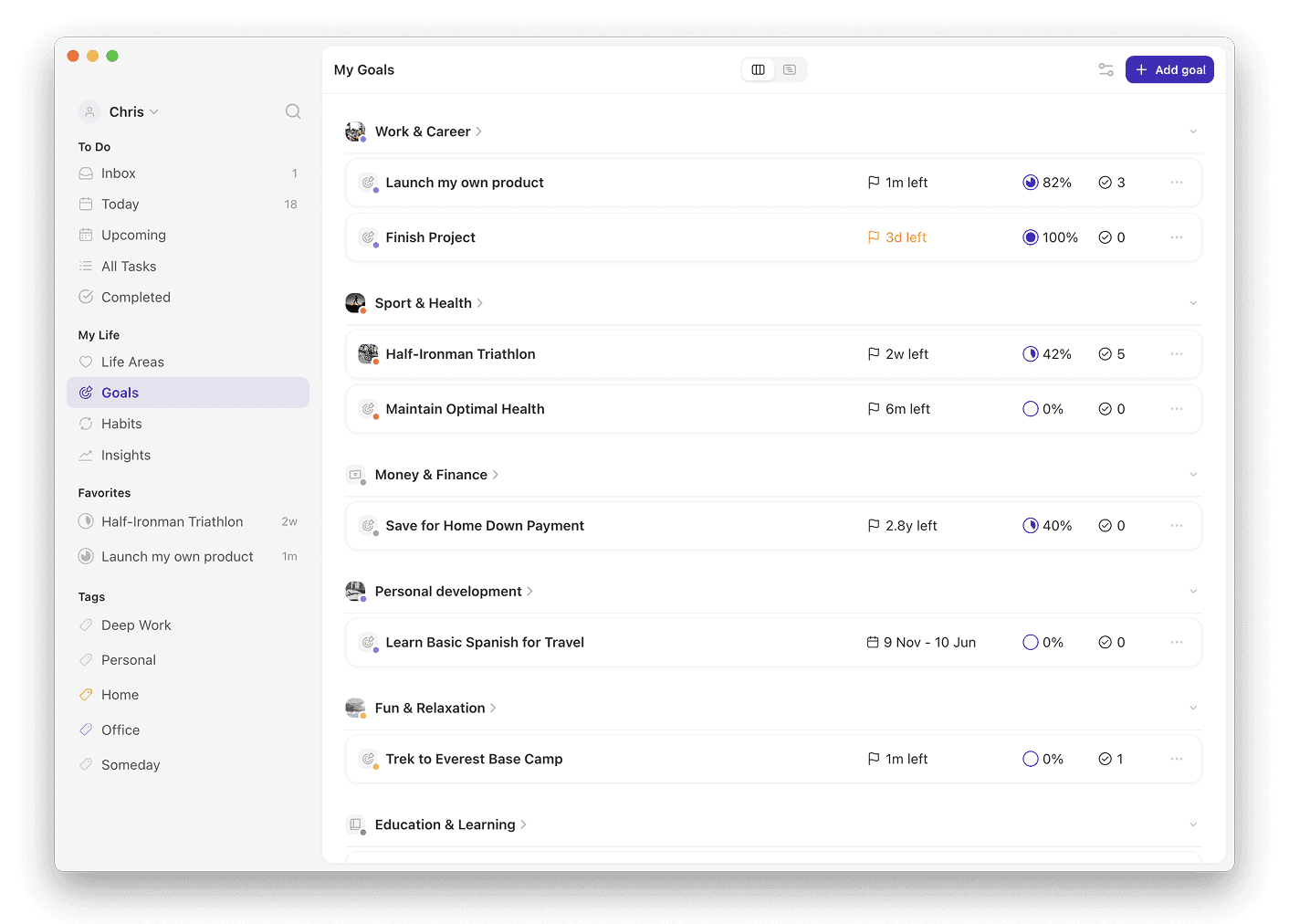
Griply keeps the structural logic (objectives ladder up to goals, goals ladder up to vision) but binds it to a single person's life areas. The hierarchy is Life area, Vision, Goal, Subgoal, Task, Habit. A Subgoal in Griply is structurally what an objective is in OKR vocabulary: a goal with a parent-goal link, a start value, a target value, and a deadline.
Griply is a lightweight goal-planner for individuals, built around daily execution. It does the same job as Lattice, 15Five, or Weekdone, but at personal scale.
How to structure a personal goal with objectives in Griply
Start with a Life area (for example, Sport & Health), then write a Vision for that area on the life area record. Create a Goal inside that life area with a name, a start value, a target value, and a deadline. Choose the target type that fits the metric.
Add Subgoals for each objective. A Subgoal has the same fields as a Goal plus a parent-goal link, so each objective gets its own metric, deadline, and progress line chart. Progress is logged manually.
Attach Tasks and Habits to each Subgoal to schedule the actual work. On Today, tasks appear next to a time-blocked calendar column and show which goal they serve. On Desktop, the premium Roadmap view lays Goals and Subgoals out over time.
Related questions
What is an example of a goal and objective?
Goal: "Run a marathon in 2027." Objectives: "Run a half-marathon by September 2026," "hit a 40km long-run by January 2027," "follow a 16-week training block starting March 2027."
What comes first, goals or objectives?
Goals come first. You set the long-horizon outcome, then derive the short-term measurable objectives that prove you are making progress. In Griply, you create the Goal first, then add Subgoals for each objective inside it.
Are goals and objectives the same thing?
No. They share the same structural shape (name, metric, deadline), but a goal is broad and long-term while an objective is short-term and measurable. In Griply, both are the same object type. A Subgoal is a Goal with a parent-goal link.
What is the difference between goal, objective, and strategy?
A goal is the outcome you want. An objective is a measurable milestone that proves progress toward it. A strategy is the approach you choose to hit the objectives. Example: goal is "save $50k in 2026," objective is "save $12k by Q2," strategy is "automate 30% of income."
How does a goal compare to a vision?
A vision describes what a life area looks like when it is going well. A goal is a measurable outcome inside that life area with a deadline. In Griply, Vision is a field on a Life area; Goal is a separate object with a start value, target value, and deadline.